To watch the YouTube video, click arrow on thumbnail below:
“I need nothing but God, and to lose myself in the heart of Jesus.” Those were the words written by an extraordinary woman whose life was utterly transformed by mystical encounters with Christ. Her name was St. Margaret Mary Alacoque, and her powerful visions of the Sacred Heart of Jesus left a lasting impact on the entire Church. If you’re ready to be inspired by the remarkable journey of this visionary saint – her profound faith, incredible supernatural encounters, and the great spiritual legacy she left behind – then keep reading as we explore the extraordinary life and mission of St. Margaret Mary, the Visionary of the Sacred Heart.
Margaret Mary Alacoque was born on July 22, 1647 in Verosvres, a small town in Burgundy, France, a region surrounded by a chain of jagged mountain peaks. She was the fifth of seven children born to Claude, the royal notary of the town, and Philiberte Lamyn Alacoque. Margaret had three older brothers and one younger brother, and two sisters, one older, one younger than she. Both sisters died young, leaving Margaret as the only surviving daughter of the family. The house of her birth consisted of two large buildings separated by a courtyard. The first house, called the cabinet house, was where Margaret was born and today is a chapel devoted to the Sacred Heart of Jesus.
During the 1600’s, the Catholic Church in France was plagued with schisms and heresy, especially Jansenism, a strict, puritanical interpretation of morality with a very limited view of salvation. The dogma of God’s infinite love for man was looked upon with coldness, indifference and doubt. Despite this, Margaret Mary’s family were devout Catholics, and Margaret was devoted to Jesus Christ from early childhood. To make her behave, all an adult had to tell her was that her behavior was offensive to God, and she altered her conduct immediately. When she was 4-1/2, Margaret went to live with her godmother, Mademoiselle de Fautrieres de Corcheval, who was childless and greatly wanted Margaret with her. Since her godmother’s castle was near Margaret’s home, and her father often traveled and would be able to visit regularly, her parents consented.
The Château de Corcheval was an imposing castle, surrounded by mountains and forests. Margaret deeply appreciated its air of solitude. Just outside the gates of the castle was a chapel shaded by trees, where she often went to pray. Two of Mme. de Corcheval’s lady companions taught Margaret to pray, read and write, and als0 taught her catechism. She developed a great and tender devotion to the Blessed Virgin Mary.
Whenever her friends couldn’t find her in prayer at home, they looked in the church, where she usually was found in deep prayer before the Blessed Sacrament. This great love of prayer helped to make her one of the greatest contemplatives of the Church. Margaret wrote in her autobiography, “I was constantly urged to repeat these words, the sense of which I did not understand: ‘My God, I consecrate to Thee my purity! My God, I make to Thee a vow of perpetual chastity!’…I did not know what I had done nor what the words ‘vow’ and ‘chastity’ signified.” She only understood them as giving the complete gift of herself to God.
In 1655, when Margaret was eight, her godmother died, and Margaret returned to her family. At the end of that same year, her father, Claude, who was only 41, died of pneumonia. Though an honest, devout Christian, he was a poor businessman who did not pay his debts nor collect his fees, leaving his family only a modest amount. Margaret’s mother was determined to remedy their financial situation, which caused her to have to travel frequently. So, her two eldest sons were sent to Cluny and the other two went to their Uncle Antoine Alacoque, a priest and the cure’ of Verosvres. Margaret was sent to the Poor Clares of Charolles. Her time there made such an impression on her that she realized this was the kind of life God wanted her to have, even though the Poor Clares Order was not hidden enough to suit her. The nuns prepared her for First Holy Communion at the age of nine. She was a lively little girl who loved playtime and amusements, but after her First Communion she no longer found them as attractive.
Shortly thereafter, she became seriously ill and had to return back home, where she was tenderly cared for by her mother and brothers. Despite their excellent care, she did not seem to be getting better. In Margaret’s own words, “They could find no cure for my malady till they gave me to the Blessed Virgin. They promised her if I were cured, I should someday be one of her daughters. They had no sooner made the vow than I was cured. I ever after experienced the Blessed Virgin’s protection…as of one belonging entirely to her.” During her long hours of convalescence, Margaret felt strongly attracted to prayer. She was more determined than ever to belong unreservedly to God.
It was only after she recovered from her illness that Margaret noticed all the unfortunate changes that had come over the household. Her mother’s efforts to reestablish the family fortune had not succeeded. A new lease of the land was made in the name of her Uncle Touissant Delaroche, who took over its management. His wife became the absolute mistress of the home, where Margaret’s grandmother Mme. Alacoque and her unmarried daughter Catherine were already living. Margaret’s mother was pushed aside, divested of any influence in the household, and treated very unkindly.
Of this Margaret wrote: “God permitted my mother to be deprived of authority in her own house and forced to yield to others. Those in charge so lorded it over her that both she and I were soon reduced to a state of captivity….We had no freedom in our own house, everything was under lock and key, so that I could not even find my apparel when I wished to go to Holy Mass. I was even obliged to borrow clothes. It was at this time that with all my strength I sought my consolation in the most Blessed Sacrament.” But because they lived in the country, far from the church, Margaret could not go to church without the permission of the family. This often was withheld with an absurd accusation that Margaret was covering up a secret rendezvous under the pretense of going to Mass or Benediction.
Hurt and frustrated, Margaret would hide in a corner of the garden, in the stable, or in some other secluded place, where she knelt and poured out her heart in tears to the Blessed Virgin. She remained there for days without eating or drinking. The other people in the village, pitying her, would come in the evening to give her some food. She would finally return to the house fearful and trembling, where she then was accused of neglecting the house and children, and was not allowed to speak in her own defense. God was her only refuge from all her trials. She prayed continuously, and began to practice austere penances.
But the greatest cross to Margaret at this time was her inability to help her mother in any significant way. When her mother became ill, she was left entirely in Margaret’s care. Margaret was unable to obtain from the head of the household the necessary nourishment for her mother, so she had to beg for eggs and other nutritious food from the people in the village. This was a great trial to Margaret, who was naturally timid and often was received very rudely. One time, her mother was gravely ill, and the doctor said that nothing short of a miracle could save her life. Margaret ran to the church and begged God to heal her mother. When she returned home, her mother was much improved and was completely healed within a few days.
Enduring her relatives’ cruelty was heroic for Margaret. She had a tender, sensitive nature and blossomed under attention and affection, which was sorely lacking in her present environment. Aside from church, her favorite spot was a little wooded area in a valley right outside the gardens that surrounded the house. This would become Margaret’s chosen refuge, where she liked to pray and where she had her first visions. From there she could see the main altar of the church, which was less than half a mile away. Leaning on a rock, she would spend hours in contemplation. At night from her window she could see the little lamp burning before the tabernacle.
It was during this difficult period that the Lord Jesus began to appear to Margaret. In her innocent way, she thought that everyone was favored with such visions, so she did not think it out of the ordinary. She usually saw Jesus crucified or carrying His cross. These visions allowed her to regard her malicious relatives as instruments through whom God would accomplish His holy will, and she was able to treat them with charity.
When Margaret was 17, her circumstances dramatically changed for the better. Her eldest brothers, who were now of age, took charge of the business affairs. Her mother was once again in a position of authority in the household. During the previous 10 years, their Uncle Toussaint, who had most likely died by this time, had regained the fortunes of the family. This meant that now Margaret and her siblings were free to enjoy their lives once again. Since most of them were of marriageable age, there was much social activity at the house. Margaret herself was attracting a lot of attention, and had already received a few good offers of marriage. In appearance, Margaret is said to have been a little above average height and of a delicate constitution. She had an expressive face with soft, clear eyes. Her personality was agreeable and vivacious, her manner cheerful and graceful, yet with keen intelligence, solid judgement, a noble soul and a great heart.

Although she maintained her pure, innocent nature, once released from her previous adversity, she now delighted in parties and amusements, cut her prayers short, and stayed away from confession. Lively and bright, she was so fond of fun that it could have led her astray, had she not constantly sought the guidance of Our Lord. At times she would be pierced by remorse, beg God for forgiveness and undertake severe penances. “In spite of all this,” she said. “I fell once again into vanity, and again I offered the same resistance.” One day, during Carnival time, she returned from a masked ball to find the Lord waiting for her. She wrote of this encounter: “My Sovereign Master presented Himself before me all disfigured as He was during his flagellation. He reproached me saying that…I was losing infinitely precious time, of which he would demand of me a rigorous account.” After this experience, Margaret wept bitterly and again subjected herself to severe penances.
She had not forgotten her vow of chastity, and did not want to marry. She felt great pressure to do so by her family, however, especially her mother, who seemed to feel that her own future would be more secure once Margaret was married and settled. On the other hand, Margaret strongly felt God’s urging to honor her earlier vow. Torn between love for God and love for her mother, Margaret suffered much mental anguish for the next several years. She wondered whether she was truly bound by her childhood vow, since she had not fully understood it at the time. She also felt that she was not worthy of a religious vocation. She decided to devote herself to the service of the poor, giving whatever extra money she had to needy children. She also taught them prayers and catechism in a large room within the Alacoque home. She visited their families and nursed the sick ones, despite the fact that she had a horror of blood, wounds and disease.
When Margaret was 20 years old, and still torn between loyalty to her mother and loyalty to God, her two older brothers died within a short time of one another. Her brother Chrysostom then became sole proprietor of the estate and head of the family, and married at the age of 22. James, her youngest brother, was preparing for Holy Orders. Her mother, remembering her past sufferings at the hands of relatives, did not want to live in a household ruled by a daughter-in-law. She tearfully begged Margaret to make a decision to marry and bring her to live with her and her husband. Chrysostom told Margaret it was high time she got married, and James offered her half of his inheritance as a dowry, to further persuade her.
In the midst of all this pressure, God came to the rescue. One day, after Holy Communion, He said to her, “If you are faithful to me, I shall never leave you. I will render you victorious over all your enemies….If you are faithful to me, I shall teach you to know me and shall manifest myself to you.” Arriving home from church, she told her family of her decision. Her mother, convinced that Margaret really meant it, no longer insisted that she marry. In her memoirs, Margaret wrote, “After this, my mother shed no more tears in my presence, but she wept before all with whom she spoke on the subject. Those persons never failed to tell me that if I left her, I would be the cause of her death.”
Despite Margaret’s resolve, her family was not yet convinced. But now she was sure of what she was going to do and lived in peace about her decision. While visiting some relatives in Macon, she learned that her cousin, a pious young woman, was preparing to enter the Ursuline convent. She urged Margaret to come with her. But Margaret preferred to enter a convent where she knew no one, so that her only motive would be the love of God.
Around this time, her brother Chrysostom arrived to take her home, because her mother was very sick and not expected to live. Margaret wrote, “They made me understand that my mother could not live without me, and that I should have to answer to God for her death. This was told to me even by ecclesiastics, which caused me cruel suffering, as I tenderly loved my mother. The devil made use of this ruse to make me believe that my mother’s death would be the cause of my eternal damnation.”
In this state of mental torment, Margaret poured out her tears and prayers at the foot of the crucifix. God answered her prayers by gradually changing the hearts of her family members. A visiting priest of the Order of St. Francis became friendly with the family and had a serious discussion with Chrysostom about his opposition to Margaret’s vocation. Fearful of offending God, Chrysostom had a long talk with Margaret and realized how determined she was about her vocation. He immediately arranged for her departure and accompanied her to the Convent of the Visitation in Paray-le-Monial, which she had decided upon. No sooner had she crossed the threshold than she heard an interior voice whisper, “Here it is that I wish you to be.” She returned home to say her last, heart-rending farewells. Upon leaving her mother, she was swept with a terrible wave of bitterness. “It seemed to me,” she said, “that my soul was being torn from my body.”
She entered the convent of the Visitation on May 25, 1671, at the age of 23. Shortly thereafter, she asked Mother Thouvant, the Mistress of Novices, just what she could do to give herself entirely to God. MotherThouvant answered, “Go place yourself before God like canvas before a painter.”
On Aug. 25, 1671, Margaret received her habit. Almost immediately afterwards, she began to sense the constant presence of the Lord. As one witness at her canonization described, “She was so united to God that, whether working, writing, or reading, she was always on her knees with such recollection as one might expect to see in church.”
The Lord appeared to her in visions from time to time, encouraging and consoling her, and sometimes reproving her for her faults. The other nuns, not knowing about this, were baffled by her behavior. As one biographer put it: “What most astonished the Sisters was not only the long hours that she passed on her knees in the choir or in her cell, her face radiant, her eyes full of tears, but the state of constant abstraction from which it was necessary to arouse her. Her work fell from her hands, and she forgot everything. The poor child’s soul was in heaven, and she did not know how to conduct herself on earth.”
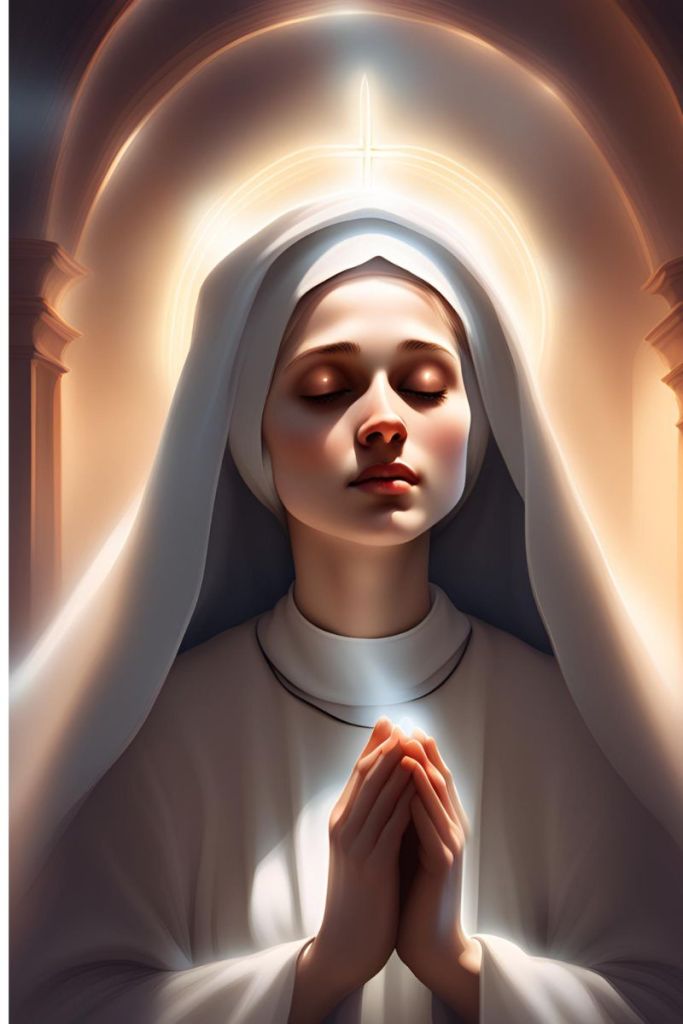
in an ecstatic state
The Mistress of Novices told Margaret that her behavior was not in accordance with the spirit of the Visitation Order, and if she did not change it she would not be allowed to profess her final vows.
Of this Margaret wrote: “I made every effort to follow the method of prayer taught me, along with other practices; but my mind retained nothing of all those teachings. The beautiful points of prayer vanished, and I could neither learn nor retain anything but what my Divine Master taught me. This made me suffer greatly, for His operations in me were frustrated as much as possible, and I had to resist Him as much as I was able.” To help her overcome her state of absorption, Margaret Mary was assigned as an aide to the Mistress of the Infirmary, who was told to keep her constantly employed. Margaret swept floors, cleaned the nuns’ cells, weeded the garden, and other such tasks. Not being allowed time for prayer, she went to the Mistress and asked if she could resume it. She was reprimanded sharply, told she needed to learn how to unite prayer and labor, and sent on to other numerous and demanding tasks.
It was now August 1672, and Margaret was not yet called to her final vows. She was admired for her humility, obedience, and charity, and although not skillful in domestic ways, she was so willing and eager that the other nuns were touched by her goodness of heart. Yet, as one witness at her canonization attested, “I heard from the Superioress and Mistress of Novices that she would one day be a saint, but that she was so extraordinary that perhaps she was not intended to live out her life at the Visitation.”
Around this time, 52-year-old Mother Marie-Francoise de Saumaise became the Superior of the Visitation convent. She possessed good judgement and fairness, was extremely kind, and had a perfect understanding of the rules of the Visitation Order. She immediately recognized in Margaret Mary the workings of the Spirit of God, and decided she should be allowed to take her final vows on Nov. 6, 1672. Following this, Margaret rapidly increased in virtue to the point that the whole community was astonished. She entered into a state of entire absorption in God. The other Sisters constantly were having to rouse her from this absorption, and they found her often in the chapel, where she knelt motionless for hours with closed eyes and joined hands, seeing and hearing nothing. But if she was asked to do something in the name of obedience, she responded immediately.
Another Sister once asked her, “My dear Sister, how can you remain kneeling so long?” Margaret replied, “At such times I do not even know that I have a body.” In today’s terms, it would seem that these were out-of-body experiences, where her spirit resided in the heavenly realm while her body remained on earth. The Sisters called her an “ecstatic.” Other saints who were considered ecstatics were Francis of Assisi, Catherine of Siena and Teresa of Avila, to name just a few.
It was during such ecstatic episodes that Margaret received the grand revelations of the Sacred Heart of Jesus. There were four distinct revelations in all, each separated by a considerable period of time. The first occurred on Dec. 27, 1673. As Margaret Mary knelt before the Blessed Sacrament, she felt entirely filled with the Divine Presence. The Lord said to her,
“My Divine Heart is so passionately in love with humankind that it cannot contain itself within the flames of its ardent charity. It must spread them abroad by your means, and manifest Itself to them.”
He told Margaret Mary nothing more at this point, except that He was going to use her to make this known to the world, but did not tell her when or how. Then Jesus asked for her heart, which she willingly gave, and placed it within His Sacred Heart.
The second revelation took place on July 2, 1674. Margaret wrote: “The Divine Heart was presented to me in a throne of flames, more resplendent than a sun, transparent as crystal. It was surrounded with a crown of thorns, signifying the punctures made in it by our sins, and a cross above.”
During the third revelation, Jesus appeared brilliant with glory, His five wounds shining like five suns. He revealed to Margaret His wish to be known, loved, and honored by all, and to draw them away from damnation. He said that the ingratitude He received from humankind in return for His great love was much more painful to Him than all He had suffered during His Passion. He promised that if an image of His Heart was venerated and worn over a person’s heart, He would “imprint His love on their hearts and destroy all unruly inclinations.”
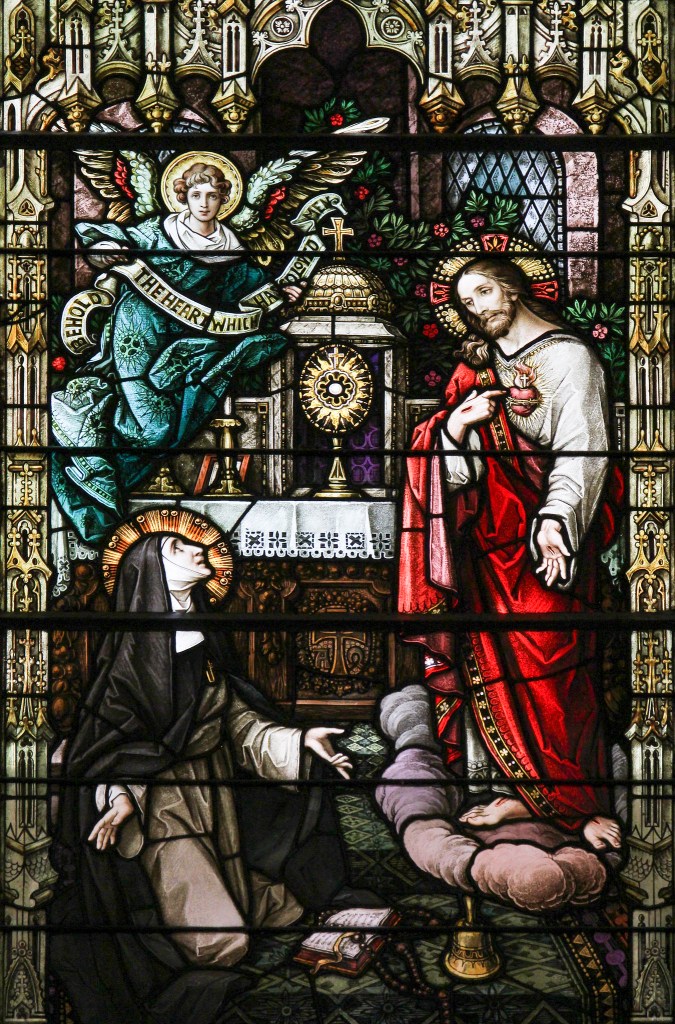
St. Margaret Mary
Shortly after this vision, Margaret Mary came down with a fever that resisted every remedy. The Mother Superior commanded her to ask God for healing, saying that she would recognize such a healing as a sign of the genuinely supernatural character of Margaret’s visions. After Margaret Mary obediently said a short prayer, her fever vanished, her pulse steadied, and the physician pronounced her cured. Now Mother de Saumaise was faced with a dilemma. The instantaneous cure seemed an acknowledgment of Sr. Margaret’s sanctity. But although Margaret’s visions were extraordinary, she was only 26 and had been a nun for merely two years. After seeking counsel, the Mother Superior concluded that Margaret Mary’s case might involve an overactive imagination and maybe some cleverly disguised illusion of the evil spirit.
When she was told this, Margaret Mary did not know what to do. She tried to resist the interior attractions, fearing that she was in error. “But I could not succeed,” she wrote. “It was impossible for me to resist the spirit that moved me.” One day, while pouring out her heart in prayer, she heard a voice say to her: “Have patience, and await My servant.” She didn’t know what the words meant, but felt comforted knowing that she would receive God’s assistance when the time was right.
It wasn’t long before Margaret Mary met this foretold “servant of the Lord,” who would become her spiritual director, invaluable friend and ally. He was Claude de la Colombiere, a 32-yr.-old Jesuit priest who arrived at the convent to give a conference to the Sisters. When Margaret Mary arrived at the conference, she naturally had no idea he was. But she distinctly heard an interior voice say, “Behold him whom I send to you.” When Fr. de la Colombiere later heard Margaret Mary’s confession, he spoke as if he knew everything that was going on in her soul. Although hesitant at first, before the priest left Paray, Margaret Mary confided everything to him. She emerged from this conversation enlightened and consoled. Father de la Colombiere had told her not to fear the guidance of the Spirit, as long as it did not interfere with her religious obedience. He advised her to follow Its instructions, and that she should make continual thanksgiving for such great favors.
On June 16, 1675, the last of the four Sacred Heart revelations took place, during which Jesus showed His Heart to St. Margaret Mary, saying “Behold the Heart that has so loved men…Instead of gratitude, I receive from most only ingratitude.” He made known to Margaret His requests for devotion to His Sacred Heart, and also made 12 promises of graces that would be bestowed upon all who follow the devotion.
For more about the Sacred Heart devotion and promises, check out my post, “Unlock the Power: The Sacred Heart Devotion”.
Then Jesus charged her with her great public mission to make devotion to His Sacred Heart known throughout the world. Margaret Mary asked, “Lord, how can I?” But Jesus told her to address herself to that servant of God who had been sent to her expressly for the accomplishment of this task — meaning, of course, Father de la Colombiere. When Margaret Mary confided all this to the priest, he asked for a written account that he could study. After examining it carefully and seeking the guidance of the Holy Spirit, Father de la Colombiere told Margaret that she could rely on it, for it indeed came from Heaven. On June 21, Margaret Mary and Father de la Colombiere solemnly consecrated themselves to the Divine Heart of Jesus.
After the last revelation, Margaret fell into a period of intense physical and mental suffering. Her health failed, and she became an object of speculation and suspicion to the other Sisters, who could not comprehend her strange mystical behavior. This is understandable, since they did not know about her visions and revelations. Only her Superiors and Father de la Colombiere knew of these. The Community was divided in opinion about her. They acknowledged her virtue, but her conduct was baffling to them. Some of the Sisters wondered if she were possessed by the devil, and some even sprinkled holy water when they passed her.
In June 1678, Mother Greyfie was elected Superior in place of Mother de Saumaise. She was an austere, rigorous character who had “an extreme distrust for the guidance of extraordinary souls.” It seems that God brought her to the convent to prove beyond a doubt the authenticity of Sister Margaret Mary’s mission. Mother Greyfie, who had heard from Mother de Saumaise about the four Sacred Heart revelations, resolved to ignore them and to see that Margaret adhered in all things to the common life of the Community. She called Margaret Mary to account for whatever went wrong in the convent, and began to take away the permissions that Margaret had previously been granted. One of these was the Holy Hour every week on the night between Thursday and Friday that our Lord had requested of her. Margaret obeyed, but when the Lord in a vision appeared irritated, she feared that a terrible punishment would come upon the community. She told this to Mother Greyfie, who paid no attention. But one day shortly thereafter, one of the youngest and most likable sisters died suddenly and unexpectedly. Mother Greyfie took this as a sign of the Lord’s anger, and quickly restored Margaret’s permission to resume her Holy Hour.
Mother Greyfie still enforced the rest of her orders upon Margaret Mary, however, and paid no attention to Margaret’s physical maladies. Even when Margaret was sick with a high fever, she was obliged to follow every exercise of the Community. Mother Greyfie did not act this way to be cruel; she was responsible for the souls of the Sisters in her charge, and did not want to be a victim of deception. To rise above her doubts once and for all, she resolved to demand a miracle that would have many witnesses. She commanded that Mary Margaret should follow all the Community exercises for five months without once returning to the infirmary due to illness. She told Margaret Mary to ask the Lord to grant her the health to be able to carry this out and not be a burden to the Community, until the the feast day of the Presentation of Our Lady, 5 months in the future. Margaret Mary proceeded to follow these instructions to the letter. There occurred an instantaneous cure, followed by perfect health. But at the end of the five months, on the day designated by Mother Greyfie, Margaret Mary’s condition relapsed so severely that God’s intervention seemed evident.
Shortly thereafter, Father de la Colombiere returned to France and once again visited the Convent in Paray. He had long conversations with Mother Greyfie about Margaret Mary, whom he had always held in high esteem. He told Mother Greyfie that he truly believed that “what passed in this dear Sister came from God.” Upon meeting with Margaret Mary again, it appeared to him that Mother Greyfie’s severity had served to increase Margaret’s virtue and the divinity of her revelations. Father de la Colombiere was by this time extremely ill, and spent his last 6 months of life in Paray. His final wish was to be buried near the altar where Jesus had appeared to Margaret Mary. He died on Feb. 15, 1682. Today he is known as St. Claude de la Colombiere, having been canonized by Pope John Paul II on May 31, 1992.
Mother Greyfie’s six years of being Superior were ending, and Mother Marie-Christine Melin took her place. She was exceedingly kind, and her personality was directly opposite from the severity of her predecessor. She understood the workings of Margaret’s soul and shared with her all the new devotions. She appointed Sister Margaret Mary Mistress of Novices. The novices loved her, because Margaret enkindled the fire of Divine love in their hearts, animated them with her words, and inspired them by example to emulate her. Without disclosing her part in the revelations, she spoke to them of the beauty and treasures of the Sacred Heart of Jesus and the graces they could obtain through devotion to it.
“The Divine Heart is an ocean full of all good things, wherein poor souls can cast all their needs,” she said. “It is an ocean full of joy to drown all our sadness, an ocean of humility to drown our folly, an ocean of mercy to those in distress, an ocean of love in which to submerge our poverty.”
Up to now, none of the Sisters except the Superiors knew that Margaret was the recipient of the Sacred Heart apparitions. But this secret was revealed one day by accident. Mother Melin asked one of the Sisters to read to the Community some notes written by Father de la Colombiere during a retreat. Towards the end of these notes, he described a conversation he’d had with the person who had received the Sacred Heart revelations. Although he did not mention Margaret Mary by name, the nun who was reading suddenly discerned that it was Margaret Mary. As she later said, “When I came to what concerned the revelation of the Sacred Heart, I looked at the venerable Sister. She was sitting with her eyes lowered and looking profoundly annihilated…The Community, feeling the same emotions, understood then that it was Margaret who had made these predictions.”
Devotion to the Sacred Heart slowly began to spread from convents and monasteries to the faithful public.. On Feb. 4, 1689, on the First Friday of the month, the first Catholic Mass in honor of the Sacred Heart of Jesus took place in the chapel of the Convent of the Visitation, in the presence of only the Community. The first public Mass in honor of the Heart was celebrated on the Feast of the Sacred Heart, 19 days after Pentecost, in the Church of the Visitation.
In 1690, Margaret Mary felt her life was drawing to a close, and she begged the Mother Superior to destroy everything that she had ever written, so that no attention would be given to her after her death. Of course, this request, made out of humility, was ignored. She was regarded by all the Sisters as a holy and privileged soul, and they privately looked upon her as already a saint. Despite her angelic and pure expression, her clear gaze seemed to penetrate one’s very soul, and she often had the ability to read hearts. But this was not intimidating, because of her sweetness and modesty. Small miracles seemed to follow her. One day, another Sister wounded herself while splitting wood with an axe. Not wanting to create a fuss, she hid the wound, but when Margaret passed nearby, she secretively touched her wound to Margaret’s garment. The next morning, there was no trace of the wound.
Margaret spoke often of her impending death, but since she was only 43 yrs. old and relatively healthy, no one took it seriously. But she sweetly and humbly insisted that it would be that year, and even told them how it would happen at a time when they were least expecting it. She even named the two Sisters whose arms would hold her as she died.
In the Fall of 1690, the day before she was to begin her retreat she came down with a slight fever. The doctor reassured the Sisters that it was nothing serious, and to all outward appearances, this seemed to be the case. But Margaret Mary, knowing better, asked for a particular Sister, saying that she wanted her nearby when she died. To this Sister, she looked to be suffering, not so much physically, but from inner, spiritual pains that were difficult to discern. Margaret Mary told the other Sister of her all-consuming desire to be with God in Heaven, but said she would remain on earth as long as God willed it.
On Oct. 16, she begged to be given Last Rites, but as she did not appear to be dying, it was refused. So she asked at least to be given Holy Communion. When the Host was brought to her, she opened her arms wide and fervently thanked Jesus for coming to her. She then received what was to be her last Communion on earth.
The next day, she had some fainting spells and again asked for Last Rites, and was again refused. The doctor said he did not feel she was near death, but Margaret replied, “You’ll see!” That evening, she had a slight convulsion, and the Sister tending her ran to call the Mother Superior. When she came, and mentioned summoning the doctor, Margaret said, “Mother, I no longer need anyone but God alone, and to be buried in the Heart of Jesus.” All the Sisters gathered around her bed, weeping. Margaret Mary rallied enough to tell them all to love God without division or reserve. She then asked once again for the Last Rites. As the priest administered the Sacrament, she tried to raise herself up for the anointing. Two Sisters went spontaneously to support her in their arms. Though no one remembered until later, these were the same two Sisters that Margaret had predicted would be holding her when she died.

Margaret Mary passed from this life to the next at 7:00 p.m. on Oct. 17, 1690, with the name of Jesus on her lips. At that moment, the cry “The saint is dead!” was proclaimed throughout the town. For two days, the townspeople came to view her body, and touched it with chaplets, medals and crucifixes to obtain a blessed relic. She was buried near the spot upon which she had knelt when the Lord appeared to her.
In 1824, the cause for the canonization of Margaret Mary Alacoque was begun. Two extraordinary cures followed. She was beatified on Sept. 4, 1864 and canonized on May 13, 1920. St. Margaret Mary is the patron saint of devotees of the Sacred Heart, those suffering from polio, and those who have lost parents. Her feast day is celebrated on October 16.

PRAYER OF ST. MARGARET MARY TO THE SACRED HEART OF JESUS
Lord Jesus, let my heart never rest until it finds You, who are its center, its love, and its happiness. By the wound in Your heart, pardon the sins that I have committed, whether out of malice or out of evil desires. Place my weak heart in Your own divine Heart, continually under Your protection and guidance, so that I may persevere in doing good and in fleeing evil until my last breath. Amen.
– St. Margaret Mary Alacoque

 Everyday Life Spirituality