PATRON OF IMMIGRANTS & FIRST U.S. CITIZEN SAINT
THE EARLY YEARS: ITALY, 1850 – 1889

To watch the YouTube video, click arrow on thumbnail below:
St. Francesca Xavier Cabrini has always been a cherished figure in my mother’s family. My introduction to her came in childhood, when a framed photo of her had a place of honor in our home—a photo that now graces my own home This deep-seated devotion stems from the connection to my maternal grandparents, Lorenzo & Angelina, who owned a bakery on First Avenue in Manhattan during the early 20th century. My grandparents had the honor of knowing Mother Cabrini, as she was called then. It was common practice for Mother Cabrini and her fellow nuns to visit local Italian businessmen seeking donations, and my grandfather’s bakery was one of their regular stops. Occasionally, Mother Cabrini would bring along some of the orphans, and my grandfather would delight in treating them all to pastries. At the end of the day, he would give away his unsold bread to her or her other Sisters. Remarkably, even today, a bakery operates at that same location, though it is no longer Italian.
I take great pride in this familial connection to such an extraordinary woman —diminutive in stature, yet monumental in her achievements — and I am grateful for the times she has listened to my prayers by interceding to God on my behalf. The film “Cabrini,” while impressive, only scratches the surface of her remarkable life. As I delved deeper into her story, I was astounded by the breadth of her travels and accomplishments. This inspired me to present her awe-inspiring life through a three-part series. Here begins Part 1: The Early Years (Italy, 1850-1889)
On the morning of July 15, 1850, in the quaint village of Sant’Angelo, nestled in the Lombardy region of Italy, Stella Cabrini, a 52-year-old woman was threshing wheat beside her husband, Agostino. She suddenly paused in her work, turned to him, and with a calm yet urgent voice, announced that their baby was ready to be born—two months earlier than expected.
The couple hurried back to their home, and Agostino summoned the midwife. As he waited anxiously, Agostino’s mind wandered to the memories of their nine children who had passed away over the years. Only three children had survived: Rosa; Maddalena, who had been disabled by polio; and Giovanni. Together, the four of them gathered in anticipation of welcoming a new family member, who would be the couple’s 13th child.
As they stood outside, a curious sight caught their attention—a flock of white doves appeared in the sky. The doves flew gracefully over the red-tiled roofs of Sant’Angelo and began circling above the Cabrini home. Agostino watched in awe; he had never seen these birds in their village before. Concerned for his grain storehouse, he and his children waved their arms to shoo the birds away. In his haste, Agostino accidentally ensnared one dove with his flail. The children rushed to gently free the bird and pleaded with their father not to harm it. Once released, the dove fluttered to rest on the windowsill of Stella’s bedroom. At that moment, a newborn’s cry pierced the air, followed by the midwife’s joyful announcement: “Agostino! It’s a girl, and pretty!” Overcome with happiness, Agostino tossed some grain into the air as an offering to the doves. The birds eagerly pecked at it before taking flight once more, disappearing into the western sky.
The family entered the room to behold the new baby cradled in Stella’s arms. Rosa exclaimed with delight at her sister’s silky blonde curls and striking blue-green eyes. Yet, amid their joy, the midwife voiced a somber warning: “She is so frail that if she lives, it will be a miracle. You must have her baptized as soon as possible.” As the hours passed and Stella regained some strength, the couple tenderly wrapped their precious baby in soft linen and made their way to the church of Sant’Angelo, where she was baptized Francesca Maria, in honor of two beloved children they had lost. Stella Cabrini lavished loving care upon her baby daughter, and against the odds, the little girl survived, although she remained frail.
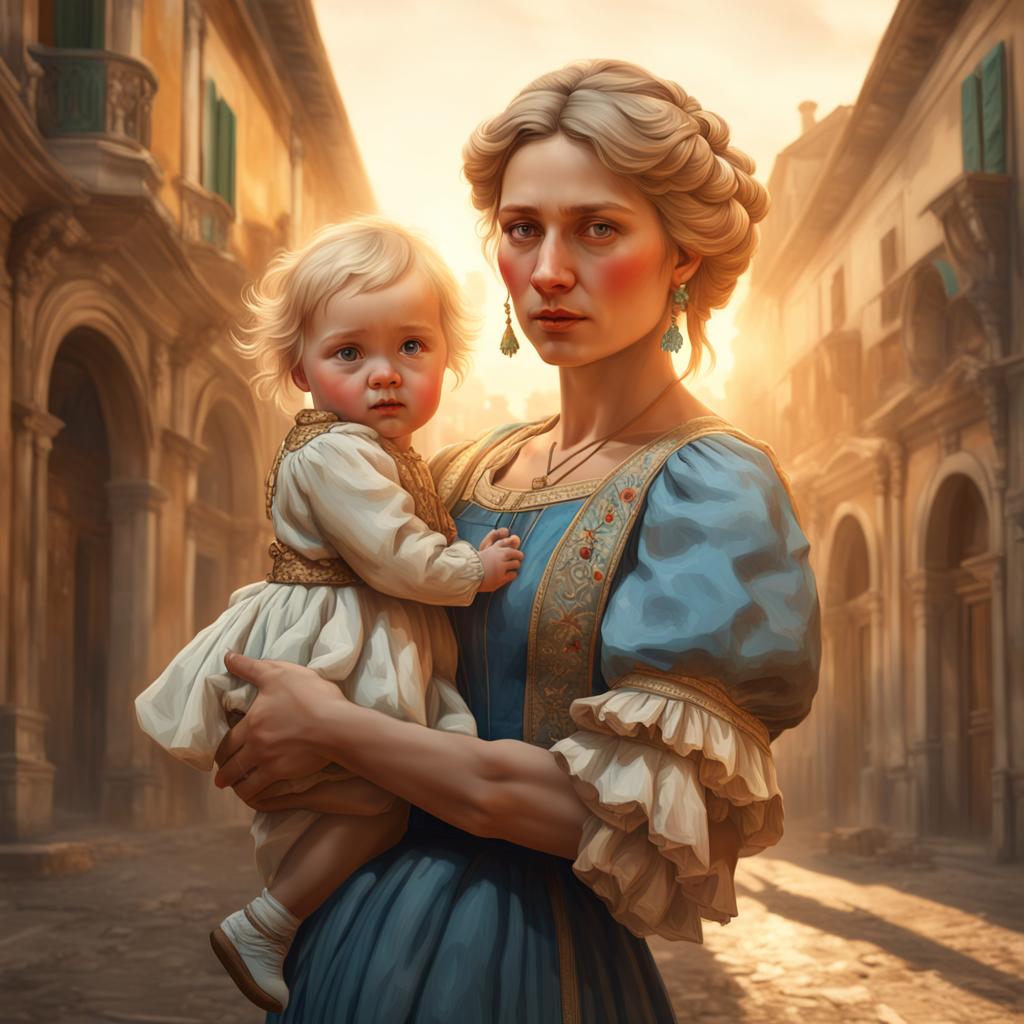
It was her sister Rosa, rather than their mother, who took on the responsibility of raising Francesca, affectionately known as Cecchina. Rosa had a stern and uncompromising demeanor that made her somewhat unlikable. Yet it may have been this very nature that instilled in Francesca a sense of determination, and conversely, an extraordinary sweetness that balanced it.
As Cecchina’s beautiful curls began to grow, Rosa was determined to curb any hint of youthful vanity. She would take a brush dipped in olive oil and press it down on Cecchina’s curls, trying to straighten them out. The stiff bristles often brought tears to the little girl’s eyes. “There, that’s better! I won’t have you looking like a silly, simpering doll!” Rosa would declare. In later years, Francesca would joke that her hair was unlikely to ever turn white, due to the excessive oiling it had endured at the hands of her sister. Despite Cecchina’s childhood admiration for Rosa, as she matured into a woman, the two could not have been more different.
As was the custom at that time, little Cecchina was confirmed before she made her First Communion. In fact, her Confirmation, which took place on July 1, 1857, was the turning point of her life. In her own words, “The moment I was being anointed with the sacred chrism, I felt what I shall never be able to express….I seemed no longer on earth. My heart was replete with the most pure joy. I cannot say what I felt, but I know it was the Holy Ghost.” Writing in a notebook many years later, she addressed to Christ, “You know that my heart has always been Yours.”
The idea of being a missionary was planted in Cecchina during the evenings when she would sit near the fireplace and listen to her father read aloud from a Catholic missionary magazine. One day, a missionary from the Orient arrived at Sant’Angelo and preached about his work. His words aroused so much enthusiasm in her that she decided she wanted to be a missionary to China. Cecchina spent many joyful days visiting her Uncle Luigi Oldini, a beloved local priest in Livagra. Recognized for his extraordinary generosity, he was known to give away his own shoes and blankets to those in need. Cecchina cherished these visits, not only because of her deep love for her uncle, but also because they allowed her to engage in a delightful game she had created—one that she couldn’t play at home. She would craft little boats from paper, filling them with violets she picked, and send them sailing down the swift current in the canals near her uncle’s house. In her imagination, these flowers were her missionaries, embarking on journeys to far-off lands.
One fateful day, when Cecchina was about eight years old, she became so absorbed in her game that she leaned too far over the stone embankment and fell into the canal. The water flowed swiftly into a tunnel, and had it not been for a timely rescue, she might have drowned. A boy who witnessed the incident rushed to Uncle Luigi’s house, shouting for help. Her uncle arrived and found Cecchina lying on the bank, drenched and shivering. He felt immense relief as she opened her eyes. Gratefully, he thanked God for her safety and asked her who had saved her. “I don’t know, Uncle,” she replied. “I just found myself lying here.” He gathered her in his arms and carried her home, suggesting that perhaps it was her Guardian Angel who had intervened. Following this terrifying experience, Cecchina developed an overwhelming fear of deep water that kept her from approaching the canal again.
Cecchina’s sister Rosa was her first teacher. Holding a normal-school certificate, Rosa ran a small private school in their town and seemed to excel at teaching. She imparted lessons in religion, a bit of French, and instilled in Cecchina a deep appreciation for their Italian language. During this time, Francesca found herself particularly captivated by geography. Hours would pass as she immersed herself in the maps of her atlas, her imagination ignited by the facts she learned about various countries around the world.

At the age of 13, Cecchina was sent to a private school run by the Daughters of the Sacred Heart in nearby Arluno. There, she spent five years pursuing courses that would qualify her to obtain a teacher’s certificate. Her frequent quotations of Latin in her letters—often without any reference books at hand—demonstrated that she had mastered the language thoroughly. She also possessed an aptitude for mathematics, a skill she would later need for important business dealings throughout her life.
As a teenager, Cecchina’s spiritual director was the pastor, Father Bassano Dede’. A man of few words, his advice to her regarding her small troubles was almost always the same. After a moment of thoughtful silence, he would simply say, “Go and tell that to Jesus.” For Cecchina, this advice proved valuable, because later in her life, circumstances made regular spiritual direction impossible. So it was all the more important that she learned early on to trust completely in Divine guidance.
Teaching was essentially the only “white-collar” job available to women at that time. Following in Rosa’s footsteps as a teacher, Cecchina obtained her certificate at 18, passing her exams cum laude. Shortly thereafter, she applied to join the religious community but was turned away by the Superior. Though the nuns were greatly edified by her presence, they doubted her strength for religious life. Had Francesca been accepted by the Sisters, it’s unlikely she would have become the great saint we’re talking about today! With no other option, Francesca returned home in the autumn of 1868, where she assisted her mother and Rosa with household chores, while dedicating herself to prayer and acts of charity.
In February of the following year, tragedy struck when her father suffered a severe stroke. He lingered for a year before passing away, soon followed by the death of her mother and her disabled sister, Maddalena. This left just Rosa, Francesca, and their brother Giovanni, who managed the family farm with help from hired hands and his two sisters. Though they lived frugally, they were not lacking in money and continued to give generously to the poor. Together, Rosa and Francesca supported and cared for an elderly woman in their town who was suffering from cancer.
A remarkable transformation occurred in Rosa following their parents’ deaths. The sternness that had made her virtue less appealing faded away. She began to show a gentle affection toward Francesca, who had often faced her sister’s harshness in the past. Now approaching middle age, Rosa realized she would have to abandon her dreams of becoming a nun, and with acceptance came a newfound sweetness. Throughout her life, Francesca always spoke of Rosa with deep gratitude.
The year 1871 passed quietly and uneventfully. However, Spring brought an epidemic of smallpox to Sant’Angelo. Both Rosa and Francesca devoted themselves to nursing the sick in their village. Francesca’s deep aversion to the sight and smell of sores made her willingness to care for smallpox patients all the more heroic. But eventually, Francesca herself fell victim to the dreadful disease. Rosa took on full-time care for her sister, lovingly bathing her face with olive oil and milk to prevent scarring. Thanks to Rosa’s devoted care, Francesca recovered without any facial disfigurement from the smallpox.
After her recovery, Father Bassano approached her with a request: would she be willing to fill in for a couple of weeks for a sick teacher at the public school in Vidardo, just 1.5 miles away? He explained that without a substitute, the teacher might be permanently replaced. Kind-hearted Francesca could not refuse. This decision resulted in her remaining in Vidardo as teacher for two years. Initially, Francesca struggled with her first teaching assignment due to the unruly behavior of her students and her own feelings of shyness and awkwardness. In an attempt to manage the situation, she adopted a strict demeanor that mirrored her sister Rosa’s temperament, which ultimately proved ineffective in engaging her students. However, Francesca soon recognized this misstep and shifted to a more relaxed, genuine, and affectionate manner, which became one of her hallmark characteristics. This change not only helped her regain control over the mischievous children but also fostered a genuine enjoyment of learning among them.
In Vidardo, she met Fr. Antonio Serrati, who would become her guide for many years. Unbeknownst to Francesca, it was he who advised the Daughters of the Sacred Heart to deny her admission when she applied for a second time, as well as the Canossian Sisters, with whom she sought to join because of their mission in China. His reasoning was grounded in her fragile health; however, now that he had become a Monsignor and the Provost of Codogno, his deeper intention was a specific task he envisioned for her.
Codogno is a charming town in the province of Lodi. In the town stood an orphanage known as the House of Providence, which had fallen into disarray. The Monsignor proposed that Francesca take on the challenge of reforming it. The institution was under the leadership of Antonia Tondini, who had endowed it with 30,000 lire, making it difficult to remove her despite her extreme unsuitability for the role. In 1872, Bishop Dominic Gelmini of Lodi successfully persuaded Tondini and her friend Teresa Calza—who lived with her—to become nuns. Although he knew they had no inclination for it, he hoped that this commitment would improve their character and behavior. They agreed to enter a novitiate with the Sisters of Nazareth but did not remain long. After a six-day retreat, they were allowed to make their profession along with their cook, a meek and mild woman named Guiseppa Alberici. They wore simple black gowns with no veil. But there any resemblance to a nun’s life ended. Not only did Tondini and Calza engage in loud and frequent quarrels, but Antonia also regularly funneled money meant for the orphanage into the hands of her irresponsible nephew, leaving the poor orphan girls neglected and often mistreated.
Francesca doubted her ability to effect any meaningful change during the two weeks that Msgr. Serrati requested of her. Nevertheless, she followed his advice and went to the House of Providence, where she was met with resentment, screams and insults from Tondini. During these outbursts, the orphan girls would seek refuge in Francesca’s room while the so-called nuns banged on the door, threatening them. Because it was clear that the girls needed Francesca, she felt compelled to stay beyond her initial two-week commitment. Although she appeared to be drifting further from her missionary aspirations, when she later reflected on her life, she recognized that each step had been Divinely orchestrated.
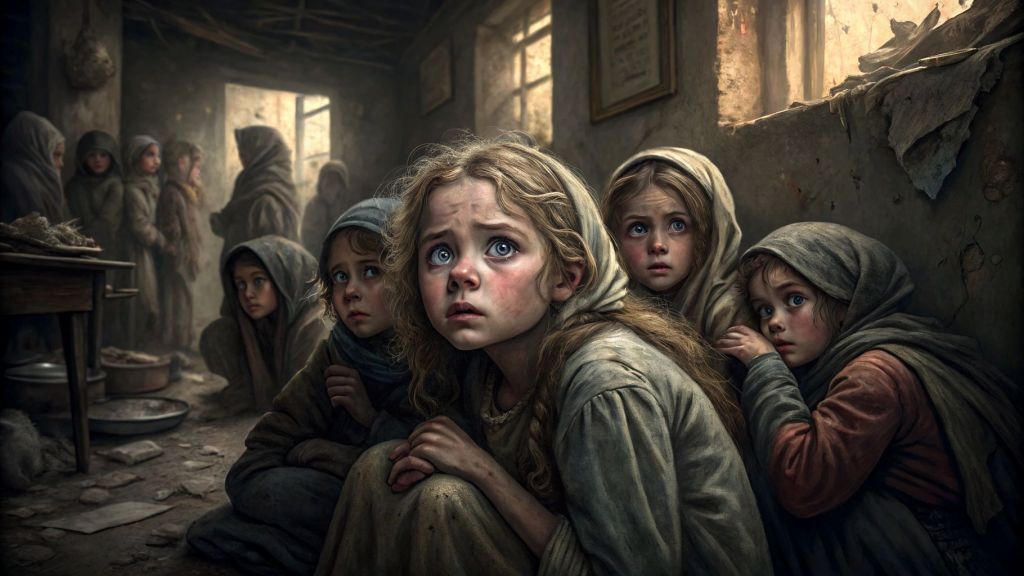
After a couple of months, hoping to improve Francesca’s situation, Monsignor Serrati and the Bishop suggested that she wear the habit to eliminate her status as an outsider. Although this felt like another sacrifice of her own plans, she agreed. She and two of her pupils were invested in the habit on October 15, 1874, soon joined by five other girls. For three years, she remained without vows—technically still a novice under the eccentric Tondini—yet she acted as a novice mistress, gathering the girls for spiritual conferences and assuring them that one day they all would become missionaries. That dream seemed more unattainable than ever, yet she clung to it fiercely. Francesca had developed a great devotion to the Sacred Heart of Jesus, and she placed her present situation trustingly into His loving care.
With supplies sent by her sister Rosa, Francesca tackled the chaos and filth of the House of Providence. Armed with fine combs, she painstakingly removed lice from the girls’ hair; baths, salves, and powders helped cure their skin ailments. She restored unsightly petticoats and dresses through washing and sewing, and taught the girls how to make bonnets and cobble their worn shoes. From her guidance, they learned self-sufficiency rather than dependency on others. She educated them in geography, mathematics, spelling and writing, while ensuring they all said their prayers. As some of the girls approached adolescence, Francesca considered the potential dangers they faced, and recognized that she would need to be their personal mother.
Francesca and her small band worked diligently at sewing and embroidery to support a new group of orphans they had taken in, which eventually swelled their numbers to about 30. The House of Providence began to function more like a true orphanage. However, Tondini seethed with frustration at any improvements made for the orphans, since they reflected poorly on her. But even all these improvements could not excuse the fact that the house of Providence was badly located.
One day, seven of the girls approached Francesca and declared, “We, too, want to become missionaries with you.” Francesca, now 27, took the girls with her to see Msgr. Serrati, where they earnestly pleaded to consecrate themselves to God through holy vows. The Monsignor gazed fondly at the petite, beautiful, golden-haired young woman he had placed in this challenging situation. Despite Tondini’s constant complaints about Francesca, she had never shown resentment or bitterness towards the odious woman. On September 14, 1877, Francesca and her seven orphan girls offered their vows of poverty, chastity, and obedience to God. She chose the name “Francesca Xavier Cabrini,” honoring the great missionary St. Francis Xavier with her middle name. The Monsignor then conferred upon her the title of Mother Cabrini, Superior of the House of Providence.
This recognition sent Tondini into a rage; her insults escalated into attempts at physical violence against Mother Cabrini. Fortunately, her new Sisters quickly gathered around her to offer protection. As the newly-appointed Superior of the House of Providence, it became Francesca’s duty to prevent Tondini from giving money to her slacker nephew. However, Tondini continued to sign promissory notes that she could not back financially. This left Francesca with no choice but to report the situation to Bishop Gelmini. By the end of 1880, the Bishop announced the termination of the House of Providence.
Now the pressing question was what would happen next for Mother Cabrini and the seven Sisters she had trained? Bishop Gelmini summoned her and said, “I know that you want to become a missionary. I know of no missionary order of women. Why not found one yourself?” Taken utterly by surprise by this unexpected turn of events, Francesca fell silent for a moment. Then, with her heart overflowing with gratitude to God, she looked at the Bishop and simply replied, “I will look for a house.” The six years Francesca had spent at the House of Providence had been marked by darkness and complexity—the most challenging years of her life. Yet by the end of that time, she had emerged fully formed and finally ready for her great calling.
Behind the Franciscan church in Codogno was a 17th-century monastery which had lain abandoned and empty since the time of Napoleon. Francesca told the Msgr. that this was where she wanted to open her convent. It was somewhat in need of repairs but solidly built and just what she needed. A young Milanese architect employed by Bishop Gelmini was commissioned to inspect the place and make an offer to the owner. Because the owner was fiercely against the church, the Msgr. instructed his friend to tell the owner that he was buying the monastery for the storage of cement. Little would he know that the cement would be of the spiritual kind! Francesca could not part with the orphans. She decided to take them with her and make of the monastery a missionary convent and orphanage combined. She also took with her Guiseppa Alberici, the meek and inoffensive cook from the house of Providence who was thrilled be included. Their fondest dream had come true; they were going to their own true home. They moved into the monastery on November 12, 1880. As she watched the orphans as running joyfully through the tall grass and wildflowers, she said to Bishop Gelmini and Monsignor Serrati: “Today his children know laughter, and their ringing voices are the bells announcing this, the new house of His Heart.”

The early days of the Codogno house were to become cherished memories for all of them. Francesca had just turned 30, yet her youthful appearance made her seem almost childlike. Her ethereal presence flitted through the Codogno house, moving with a lightness and swiftness that fascinated those around her. Despite this delicate exterior, she was a remarkably mature, determined, and wise woman. She possessed an endearing charm and charisma that won her friends wherever she went. She never struggled to attract vocations; instead, she drew souls to her, igniting their spirits with her fervor and ideals.
One night, a sister in an adjoining bed awoke, startled to see a radiant light surrounding Francesca’s short golden hair and face. Her expression was one of transfiguration, and her eyes reflected a vision ablaze with fervor. Alarmed, the sister cried out, causing the light to vanish. Mother Cabrini, noticing the commotion, asked, “What’s wrong, Daughter?” The Sister replied breathlessly, “The light! Mother, did you see it?” “Yes, daughter. It was nothing. Pray yourself back to sleep.” From that moment on, Francesca Cabrini would sleep alone in a small room.
There was much work ahead before she could hope to see her fledgling order thrive. Francesca and her Sisters went door to door in Codogno, appealing for donations of furnishings and money. She arranged credit with local merchants for flour, groceries, charcoal, milk, eggs, vegetables, meats and fish. She aimed to furnish the chapel and establish a private school within the house to generate income for supporting orphans. Simultaneously, she began formulating regulations for her Order. Her guiding principles would not consist of a convoluted theological maze or useless mortifications, but would instead focus clearly on imitating Christ. The Institute would embody the spirit of the Holy Family, ensuring all members were equal in love without preference or favoritism. They would wear simple, practical habits that would not hinder their labor. No veil was worn, but only a white bonnet, until Mother Cabrini and her first group of nuns later went to America, at which time they adopted a veil of black, lightweight fabric.
Francesca envisioned each new house as being independent and self-sufficient through begging, subscriptions, soliciting donations, and accepting paying pupils. The Mother Superior of each House would be chosen by Francesca based solely on administrative capability rather than sentimentality. She was resolute about not turning away those who were worthy, regardless of their physical strength. As time passed, more orphans and aspiring nuns sought refuge in her house; within a year of its purchase, it had to be enlarged.
From the outset, the question of what was possible and what was not was set aside. This was not due to any overconfidence; Francesca was naturally unassertive, retiring, and even timid. Rather, it stemmed from her deep faith in God. Almost daily, she would express the words of St. Paul: “I can do all things in Him who strengthens me.” These words became her personal motto and later the guiding principle of the Institute. She encouraged all the Sisters to embrace this same trust, telling them, “None of us will fail if we leave everything in the hands of God. Under Him, the question of possible and impossible ceases to have any meaning.”
It quickly became clear to the nuns at Codogno that they could expect anything to happen. A series of incidents unfolded that, while some could be explained through natural means, hinted at the marvelous—perhaps even the miraculous. Francesca herself refrained from labeling them as miracles, yet she could not prevent the Sisters from viewing them as such. These extraordinary events would continue throughout her life.
On one occasion, a Sister was sent to the kitchen to assist the cook, who was in distress over an empty milk container. The Sister approached Francesca’s room to report the situation and seek guidance. “Are you sure you looked well?” Francesca asked. “Yes, Mother. Sister Frances and I both checked. There isn’t a drop.” Raising her eyes heavenward, Mother Cabrini moved her lips in prayer before smiling and instructing, “Go down and look again more thoroughly this time.” The Sister complied and discovered that the can was filled to the brim.
In another instance, when Francesca learned from a Sister that the bread bin held only a few stale crusts, she said confidently, “You couldn’t have looked properly. Go look again.” The Sister was certain there was no bread left, but obeyed nonetheless—and found the bin overflowing with fresh loaves that they could not account for, since they had no money to purchase bread.
Father Gallone, the provost from the nearby town of Grumello, approached her with a request to open a school in his diocese. The establishment of this first branch of the Missionary Sisters of the Sacred Heart brought Francesca nearly as much joy as founding the Mother house in Codogno itself. By 1887, seven houses had blossomed under her guidance. At 37 years old, she felt an increasing impatience to embark on the missionary work she had long envisioned. She confided in Msgr. Serrati about her desire to establish her Institute in Rome and seek approval for missions across far lands. However, Msgr. Serrati hesitated at the enormity of her ambitions and suggested that such extraordinary endeavors should be left for saints.
One night, Francesca dreamt that the Christ Child appeared to her and said: “Francesca, go to Rome.” This gave her the determination to pursue her goal. Despite Msgr. Serrati’s attempts to discourage her, she firmly responded: “Dear and good Msgr. Serrati, I will not be deterred from the Way.” Reluctantly, he penned letters to acquaintances with connections in Rome. On September 24, 1887, Francesca and Sister Serafina boarded a train bound for Rome. As they traveled along the coast, Francesca gazed out at the sea for the first time — an awe-inspiring sight that marked another step in her extraordinary journey. At that moment, her phobia of water disappeared. She now regarded it as a symbol of the enormity of God, and as her road to the missions.

Francesca had two primary objectives for her journey to Rome: to secure papal approval for her Institute and to obtain permission to open a House in that city, from which all subsequent operations of the Institute could be directed. Upon arriving in Rome, she quickly learned that the key figure for her ambitions was Cardinal-Vicar Lucido Parocchi. Without delay, she sought an appointment, and after three days of waiting, the important prelate agreed to meet with her.
During their meeting, he questioned her about her Order and her intentions. Her swift and candid responses seemed to please him, eliciting a smile. However, he cautioned her that if he were to grant every fledgling Order’s request, every building in Rome would become an Institute. He graciously reviewed her handful of papers regarding the Missionary Sisters of the Sacred Heart but pointed out significant gaps: where were the letters of recommendation? Where were the financial resources? Could she possibly raise a half-million lire to establish and sustain a Motherhouse in Rome?
“Francesca Cabrini, youthful mother,” he told her, “you are well appreciated in Codogno. Leave to the hands of the strong the foreign missions. Your Institute is too small, its background brief, and it has no money. For now, I suggest that you take your dream back with you to Codogno.”
Standing before him, she replied resolutely, “Forgive me, your Eminence. I will stay in Rome, for I know our Lord will change your heart. I thank you. God bless you.” It was only when she stepped out onto the street that she allowed her tears of disappointment to flow freely.
Thus began Francesca’s exhausting quest for approval and support to establish the Missionary Sisters of the Sacred Heart in Rome. She often went without meals from dawn until dusk, knocking on every ecclesiastical door she could find, waiting hours in ante-chambers, writing letters, and walking endlessly through rain and cold in worn shoes. Despite her tireless efforts, she received little more than cautious advice and discouragement.
Francesca managed to secure a few more meetings with Cardinal Parocchi, who began to admire both the breadth of her vision and the passionate glow of her character. He found it increasingly difficult to resist her fervor. Finally, on the afternoon of October 22, he asked her pointedly, “Now, Francesca Cabrini, will you be obedient?” When she affirmed her willingness, he smiled and said, “Good. Well then, instead of the house you desire here for your missionary sisters, I request you to open two houses! I want you to establish a free school here in Porta Pia and a nursery in the suburb of Aspra. I can equip the schools, but your sisters will have to support themselves and pay rent.”
Overjoyed by this unexpected opportunity, Francesca shared the news with Msgr. Serrati in a letter. He responded enthusiastically, sending her every lire he could gather or borrow. With this support, she rented an unfurnished apartment on Via Nomentana and scoured junk shops and auctions for affordable furnishings. The apartment on Via Nomentana became the Rome Motherhouse for her Institute. Soon after, five of her Daughters arrived from Codogno to join her.
The Cardinal-Vicar Parocchi observed Francesca’s unswerving passion for Christ, as well as her remarkable wisdom and industriousness as she successfully established the schools at Porta Pia and Aspra with limited funds. She became dear to the Cardinal-Vicar, who, unbeknownst to her, highly recommended her at the Vatican. On March 12, 1888, she received a momentous acknowledgment from the Vatican: the recognition and approval of her Institute.
As she embarked on the ambitious project of opening a college in Piacenza, she forged a significant friendship with Bishop Giovanni Scalabrini. This relationship would herald her true mission in life. Bishop Scalabrini was deeply committed to providing moral and spiritual support to the ever-growing tide of Italian emigrants heading to America. The economic crisis of 1887 had prompted the Italian government to encourage emigration, leading to an annual outflow of approximately a quarter of a million people from Central and Southern Italy seeking work in labor-hungry America. Bishop Scalabrini took the emigrant cause to heart. He founded the St. Raphael’s Society, and in 1888, the Congregation of St. Charles Borromeo to minister to the emigrants’ spiritual needs. Two priests and a lay brother had taken over a former Protestant church in New York City, dedicating it to St. Joachim, while five other priests and two lay brothers had gone to South America to work with Italian emigrants there. Although the Bishop was doing what he could, it was pitifully inadequate. But when he met Francesca Cabrini, he recognized in her the ideal person for this mission. He spoke passionately to her about the plight of emigrants, declaring, “America needs your Missionary Sisters of the Sacred Heart, for there are prodigious works of light to be done.”
He had already spoken with Archbishop Corrigan of New York during a visit to Rome, who expressed a sincere desire for her to come and assist with orphanage work. When he mentioned this to Francesca, she replied, “But New York is too small a place for me.” The Bishop smiled. “Well, you ought to find the whole country of the United States large enough!” But Francesca smiled back and declared, “No, Your Excellency. For me the whole world is too small!”
At last, at the age of 38, Francesca was presented with the opportunity to cross the ocean. Yet, as she contemplated her journey to America, although far from the dark realms of China, Japan, India, and Africa, she felt an unexpected wave of fear wash over her. Uncertain about what lay ahead, she found herself at a crossroads, not knowing what God wanted her to do. However, on the eve of her long-anticipated audience with the Pope, she experienced a vivid dream. In it, her mother appeared alongside several saints and the Virgin Mary. Finally, Jesus Himself came to her, His Sacred Heart glowing with love and reassurance. He urged her gently: “Be courageous and fear not, for I am ever with you, and with Me you can do all things.”

The next morning, Bishop Scalabrini arrived in a carriage. Before he could speak, she shared her dream with him. He laughed joyfully and produced a letter from his pocket. “Here now is the dream you speak of,” he said. “It just came—a letter from New York. Archbishop Corrigan has an orphanage waiting for you there. Now you can actually depart for America!”
When Francesca finally met Pope Leo XIII, he was 78 years old and had been pontiff for ten years. His unique perspective on society encompassed concern for all classes—from the poor and humble to the affluent. He engaged her in conversation about her family, village life, childhood dreams, education, and the founding of her Institute. As he spoke, his demeanor reminded Francesca fondly of her father. He told her with a gentle chuckle that he was already well-acquainted with her story, but enjoyed hearing it from her own lips. He told her, “Sweet daughter, Cardinal Parocchi and others among my good sons tell me your dream of bearing light to the Orient.” He paused before shaking his head slowly. “No,” he said firmly. “The house and family of western civilization must first be put in order. Hundreds of thousands of our Italian souls in America have become lost like battered sheep—isolated from Christ and ordinary decency. The New World cries for the warmth and compassion of a mother’s heart—one tempered by love and sacrifice—the heart of an apostle.” He looked directly at Francesca Cabrini and declared: “You have that very heart. My daughter, your field awaits you not in the East but in the West. Francesca Cabrini, go to America! Plant there and cultivate the beautiful fruit of Christ!”
Back at the Codogno house, excitement filled the air as Francesca Cabrini attended a jubilant Mass celebrated by Bishop Scalabrini, with Monsignor Serrati also in attendance. The atmosphere was charged with joy, yet beneath it lay a current of urgency. Francesca and her six daughters had little time to prepare for their journey to Paris, where they would proceed to La Havre. They hastily packed their few personal belongings before bidding farewell. Bishop Scalabrini, with a warm smile, blessed each of the emigrating missionaries, presenting them with rosaries and crucifixes to carry with them on their new adventure.
On the morning of March 23, 1889, at the port of La Havre, Francesca and her daughters ascended the gangplank of the old French liner, Bourgogne (Burg-O-nya). As soon as the ship set sail, however, her daughters began to succumb to seasickness, one by one. Panic-stricken, they fled to their cabin in search of refuge from the rolling waves, leaving only Mother Cabrini remaining on deck. Were these the brave missionaries she had envisioned for America?
Among the 1,300 passengers aboard, 900 were emigrants crammed below deck in steerage—700 Italians and 200 Swiss. Though her daughters struggled with seasickness, they descended with Francesca into the depths of the ship to mingle with the emigrants. Almost everyone was battling nausea and despair. Yet when she spoke to them in their rich Italian dialect, their spirits lifted; they became animated and welcoming. Some of the men rallied around her, gallantly assisting in comforting the elderly and young children who were suffering.
On March 31, the first glimpse of American land appeared on the horizon. As dusk fell, the ship entered New York Bay. Towering above them stood the Statue of Liberty, silently holding aloft her burning torch—a beacon welcoming all who sought refuge and opportunity in this new land. Francesca Cabrini’s heart swelled with hope as she prepared to embark on her mission among those who needed it most.

Coming in Part Two: The New World – New York, Nicaragua, New Orleans

 Everyday Life Spirituality