PATRON SAINT OF IMMIGRANTS
THE NEW WORLD: NEW YORK, NICARAGUA, NEW ORLEANS

TO WATCH THE YOUTUBE VIDEO, CLICK ARROW IN THUMBNAIL BELOW:
On March 31, 1889, the SS La Bourgogne docked at Ellis Island, NY. Among the throng of hopeful immigrants stood a small, fragile-looking woman dressed in a nun’s habit. Although she was almost 40 years old, her petite frame and innocent blue eyes made her appear hardly more than a child. Yet, this unassuming exterior housed an invincible spirit. Her name was Mother Francesca Xavier Cabrini, and accompanying her were six young nuns, all members of the Missionary Sisters of the Sacred Heart of Jesus, an Order she had founded less than a decade earlier. Sent by Pope Leo XIII, Mother Cabrini and her companions were charged with the monumental task of providing spiritual solace and material aid to the burgeoning Italian immigrant community in New York City. As they set foot on Ellis Island, little would anyone suspect that this unassuming group of nuns, led by their visionary founder, would soon transform the lives of countless Italian orphans and immigrants in New York, and then go on to establish a vast network of schools, orphanages, and hospitals all across North, Central and South America — and beyond.
As the fog lifted on that early morning, Father Felice Morelli and another priest approached the weary group of nuns. They explained that they were there to meet the Sisters and take them to St. Joachim’s Church on Roosevelt Street. At the rectory the nuns, hungry and tired from their long journey, were treated to a hearty Italian meal, which they gratefully devoured. Throughout the dinner, Mother Cabrini sensed an undercurrent of uneasiness from their hosts. When the meal ended, she politely suggested it was time for them to retire to their convent. A tense silence fell over the room before Father Morelli reluctantly admitted, “It is not our fault, Mother Cabrini, but the fact is…there is no convent.”
Francesca’s blue eyes widened in disbelief. “No convent!” she exclaimed. “But I was assured one would be ready for us!” Father Morelli could only offer a vague explanation, promising that Archbishop Corrigan would clarify the situation the following day. “But what are we to do for tonight?” Francesca asked. Father Morelli suggested a hotel, but with telephones still being a rarity, securing such accommodations proved too difficult. Eventually, he proposed a nearby rooming house in one of the Little Italy neighborhoods. Mother Cabrini agreed, and the priests took them to a rooming house where the nuns, now on the brink of collapse, looked forward to finally getting some much-needed rest.
Upon entering their room, the sisters quickly realized that sleep would be an elusive luxury. One of the nuns shrieked in horror as she pulled back a blanket, revealing sheets and blankets teeming with bedbugs. Nor could they could bring themselves to stretch out on the filthy boards of the floor. In the Institute’s early days, they had often made do with straw bedding, but though their convents in Italy were bare, they were immaculately clean. While poverty was one thing, this level of squalor was quite another. In that moment of despair, Francesca found the strength to uplift her companions. “My daughters,” she encouraged, “we are missionaries, and as such, we must be prepared for trials like these. This hardship is surely a sign of God’s impending blessing upon us!” They resorted to taking turns sitting in the few chairs, resting their heads on the table or against the wall. Their fitful attempts at sleep were frequently interrupted by sudden jerks awake, imagining vermin crawling over them. In the darkness, mice and other vermin scurried across the room. Francesca, naturally fastidious and terrified of mice, made no attempt to sleep herself, though she encouraged the sisters to rest as best they could. Instead, she spent the night in prayer for the great challenge that lay ahead of them.

And a challenge it certainly would be! The Italian immigrants who arrived in America in the late 19th and early 20th centuries faced immense hardship and suffering. Crowded into unsanitary slums, they were exposed to ruthless exploitation, often at the hands of their own countrymen who acted as unscrupulous agents and padroni. The newcomers were relegated to the most dangerous, poorly paid, and thankless jobs. Of the nearly 4 million Italian immigrants who came during this period, about 1-1/2 million eventually returned to Italy, unable to establish themselves successfully in the New World.
Life in America’s “Little Italy” neighborhoods was harsh. Forced into the most dangerous and grueling jobs – the only work available to them, which other immigrant groups, such as the Irish, had moved on from – many Italians faced frequent injuries, permanent disabilities, and even death. Their children ran wild in the streets, with some resorting to selling newspapers or shining shoes to earn a bit of money. In these moments of crisis, they had nowhere to turn for support or solace. For those who fell ill, the public hospitals offered little comfort. Many men learned only enough English to perform their jobs, while the women often learned none at all. Unable to communicate effectively with doctors due to the language barrier, many suffered in silence or died in utter loneliness. When tragedy struck, the children were often taken away and placed in institutions, where they inevitably lost the remnants of their faith and culture. Those men fortunate enough to recover from illness or injury returned to lives of crushing poverty and squalor. Despite these immense challenges, from a labor standpoint the Italians were generally viewed as useful to American society.
A major challenge was the provincial loyalties the Italians brought with them. Rather than uniting as a single community, they formed small enclaves based on their specific regions of origin within Italy. This factionalism made it difficult to organize for common causes or improvements. Another serious issue was that about two-thirds of the immigrants were men, often separated from their families. This upheaval, combined with the presence of some criminal elements, unfairly tarnished the reputation of all Italians, despite the fact that most were hardworking and law-abiding.
The Italians found little opportunity to practice their Catholicism in America, as they lacked the religious infrastructure that had aided other immigrant communities. While the Irish had plenty of priests, and the Germans had pastors and religious orders who spoke their language, the Italians had no such spiritual or cultural support. When they went to church, they often had the humiliating experience of being relegated to basement chapels. Those who did hear Mass regularly could seldom find a priest able to hear their confession. Not even when dying could they find a priest to attend them.
Archbishop Michael Augustine Corrigan, at the age of 50, had already served as a Bishop for 16 years. A kind man, he was known for his frequent smile, which helped to conceal a slight facial imperfection, earning him the disparaging nickname “Smiling Mickey” from his detractors. He was fluent in several languages, including Italian. However, when Mother Cabrini and her Sisters arrived at his office the next day, they were greeted not by his characteristic smile, but by a look of surprise and mild annoyance. “But didn’t you get my letter asking you not to come yet?” Archbishop Corrigan asked in Italian, his brow furrowed.
Mother Cabrini replied calmly, “No, Your Excellency. The letter must have crossed the Atlantic while we were on our way here. Bishop Scalabrini assured me that everything was prepared, but I arrive to find that nothing is ready. I wrote to you in February, mentioning that I might come in May or possibly before.”
The Archbishop sighed, “Even so, I hadn’t counted on your arriving so soon! I had written to you requesting a postponement of your departure from Rome. As of yet, we have no house for Italian orphans. The complexities and prejudices here present obstacles too significant for you to overcome. It’s unfortunate that you’ve crossed the ocean for nothing; however, I see no alternative but for you and your Sisters to return to Italy. I’m truly sorry.”
Francesca, however, stood her ground. “No, Your Excellency, we cannot do that. I came to New York under obedience to the Holy Father, and so I shall remain here.” She presented him with her carefully preserved bundle of letters. Archbishop Corrigan glanced at the documents, realizing the truth of her words. Faced with a direct order from the Pope himself, he knew he could not oppose it. Moreover, Francesca’s passion and resolve made a strong impression on him. Like so many before him who had looked into Francesca’s candid blue eyes, the Archbishop sensed that she was not someone to be easily dissuaded. Therefore, he decided to help the determined nuns. He personally escorted them to the convent of the Sisters of Charity, located at the corner of 51st Street and Madison Avenue. There they were warmly received by the Irish Superior, Mother Mary Martha, who immediately welcomed the homeless Italian nuns.
Francesca soon discovered the root of her difficulties regarding the orphanage: Mary Reid, an American woman married to Italian Count Cesnola, had generously donated $5,000 and selected a house on East 59th Street to be used for Italian orphans. However, Archbishop Corrigan opposed the location, fearing it would draw unwanted attention and reignite hostility towards Italians in the affluent neighborhood. Knowing how recently his own people, the Irish, had experienced American animosity, he was afraid of arousing it once again. During a subsequent meeting, Archbishop Corrigan explained his concerns to Mother Cabrini. “As long as the Italians inconspicuously keep to their Little Italies, there’s no harm done. But bringing a bunch of Italian orphans swarming onto 59th Street is inviting disaster! You can send some of your Sisters to teach at St. Joachim’s parish, and if you can find a house for an orphanage downtown, that would be all right.”
But because Countess Cesnola had already paid for rental of the 59th St. house, Mother Cabrini persuaded the Archbishop to meet with Countess. During that meeting, he shifted his argument, claiming that their funds were insufficient to maintain the orphanage in such an expensive area. Seizing her opportunity, the clever Countess dramatically knelt and exclaimed, “Your Excellency, remember that in the Lord’s Prayer we ask only for our daily bread – not bread for a year!” Archbishop Corrigan sighed. “All right, all right,” he conceded. “Since you have already rented that house, Mother Cabrini can take possession of it.”
On April 21, just three weeks later, Francesca and the Sisters moved into their new home. They were greeted by a statue of the Sacred Heart of Jesus at the entrance, with a loaf of bread placed at its base. Delighted by this auspicious sign, Francesca declared, “You see! Providence is never going to desert our little orphans!” The following Palm Sunday, Archbishop Corrigan visited, presenting Francesca with a blessed palm. She interpreted this gesture as a triumphant sign heralding the beginning of her great missionary career.
Five days after moving in, two disheveled little girls in tattered clothing became the orphanage’s first residents. Francesca welcomed them warmly, saying, “Remember, I am your mother, and you have a mother in every one of these Sisters. This is your home now.” She immediately set to work bathing them and untangling their hair. Resourcefully, she fashioned dresses for them from her own petticoat. Years later, one of these girls would join Francesca’s Missionary Sisters.

Acknowledging Archbishop Corrigan’s concerns about funding, Francesca sought ways to increase their resources. After being turned down by the Italian Consul in New York and other Italian officials, she realized that personal donations were their only hope. Sympathetic, wealthy women, including the Countess’ daughters, solicited contributions from their social circles, often supplementing the funds with their own money. Francesca and the Sisters also canvassed New York’s Little Italy, particularly Mulberry Street. They learned to navigate the diverse Italian communities, which each retained their distinct customs and dialects. Despite occasional cold receptions, they received many donations of money and food. Though most contributions were small, and the orphanage’s existence remained precarious, they managed to survive. Within four months, the orphanage housed 400 destitute children.
Even before the orphanage opened, Francesca had sent Sisters to work at Fr. Morelli’s parish, St. Joachim’s. She believed that establishing schools for poor Italian children, where both Italian traditions and religion could be preserved, was crucial to her Order’s mission. Initially, the Sisters supervised children during Sunday Mass, taught catechism in the afternoon, and offered Christian doctrine conferences in Italian to older girls and young women. By late April, they had established a day school within the church itself. Classes were held in the choir loft and beneath it (with a curtain for privacy), as well as in a room off the sacristy. Despite the lack of desks and limited books, they managed to instruct 200 children daily. Under Mother Cabrini’s nurturing care, the children flourished. During her school visits, they would gather around her eagerly, and she often presented each child with a small token, even if it was just a piece of candy. In return, the children offered their own little gifts to the Sisters.
Francesca’s efforts extended beyond the makeshift school. She and her nuns ventured into the immigrants’ homes, even in areas where the police were wary of entering. As a result, hundreds of Italian immigrants were encouraged to re-embrace their faith. Even adults who were not personally inclined to religious practice were willing to have their children instructed in the faith.
In May of 1889, a NY newspaper reported: “This week, young ladies with radiant faces, dressed in plain black religious hoods and robes, were seen coursing the overcrowded streets of Little Italy….They are the pioneers of a congregation called the Missionary Sisters of the Sacred Heart, and in the short period of a month have already founded a school and orphanage….The Directoress of their congregation is ‘Madre Francesca Cabrini,’ a diminutive, youthful lady with great eyes and an attractive, smiling face. She does not know the English language, but she knows the universal language of the human spirit.”
Convinced of her Divine calling, Francesca would pore over maps of the United States, calculating distances and identifying strategic locations for future endeavors. To keep up with news and current trends, she would read the Italian newspaper, Il Progresso, and several New York papers, learning English by comparing stories of the same events. Despite the immense challenges ahead, she placed absolute trust in God’s guidance. By now, Francesca had developed a strong friendship with Archbishop Corrigan, who recognized the immense value of the Sisters’ work. To familiarize her with American life, he occasionally invited her on his countryside visits. During one such outing in Peekskill, he gestured across the Hudson River and declared, “Now, there, Mother, is where you should establish yourself!” Francesca responded, “May it please God, your Excellency, that you will prove to be a prophet!”
On July 20, Francesca embarked on a journey back to Italy, accompanied by two Irish postulants from New York City. She returned to the Motherhouse in Codogno to select additional nuns for her American mission. She was now 40 years old. Most of the Sisters were considerably younger, some still teenagers, infusing the Institute with a youthful vigor and an adventurous spirit, inspired by Mother Francesca Cabrini’s own invincible character. But amidst the excitement, there was sorrow when Guiseppa Alberici, the cook and Francesca’s longtime friend, passed away suddenly, severing another link to her past. Francesca spent a month at Codogno motivating her nuns, before visiting each of her Lombardy convents. The Sisters rejoiced at their Mother’s presence, many hoping to be chosen for the missions. In Rome, Francesca had a private audience with Pope Leo XIII, updating him on their progress and ongoing needs. After receiving his encouragement and blessing, she felt more than ever that the Pope was her steadfast friend and supporter.
While in Italy, Francesca had a vivid dream of a grand house on a wooded estate nestled alongside a wide river, surrounded by farmlands and orchards. Shortly afterwards, Archbishop Corrigan informed her by letter that the Jesuits were relinquishing their novitiate in the Catskills and relocating to the eastern bank of the Hudson River. They offered their property to Mother Cabrini at a remarkably low price. The estate boasted extensive grounds, farmland and orchards, two large houses and a smaller one. As yet unbeknownst to Francesca, the water supply was inadequate, but the offer remained a bargain, with favorable terms and financial backing promised from Italian friends. Recalling her dream, she wondered if this could be the place she had envisioned.
On April 18, 1890, as Francesca sailed back to New York, her anticipation grew. During this voyage, she began penning a series of diary-letters to her nuns in Italy, which later became an invaluable resource for her biographers. These letters were not only edifying and encouraging, but often chatty and amusing, revealing the captivating personality that charmed people wherever she went. Francesca Cabrini had a remarkable ability to bring out kindness in others. On every voyage, she quickly became a favorite among the ship’s company. She made it a habit to approach the head of the steamship agency, and once on board, introduce herself to the Captain and his staff. Invariably charmed, they would go out of their way to make her and the Sisters’ journey more comfortable. Francesca’s personal charisma likely contributed to her ability to accomplish so much with limited financial resources. She often received what she asked for, and frequently, people eagerly offered gifts and favors without her even having to ask.
Francesca grew to enjoy the ocean voyages, as they provided her only opportunities for rest, and may well have contributed to her longevity. Despite her former fear of deep water, she claimed to never feel better than when breathing the clean ocean air. Even so, she found courage to brave the water only when necessary for her mission, and avoided any boat rides that were strictly recreational.
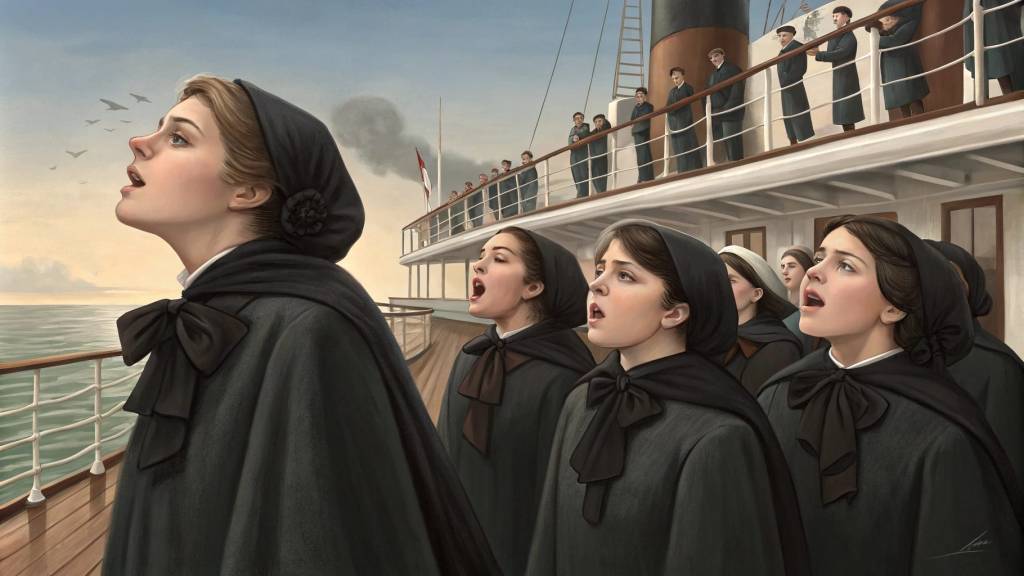
One night during Mother Cabrini’s voyage back to New York, the ship’s engine malfunctioned, forcing it to halt for repairs. Awakened by the fog horns, she quickly dressed and comforted the frightened Sisters, spending the remainder of the night in prayer. Come morning, she discovered that the ship was encircled by massive icebergs. The gravity of their situation struck her: had the engine not broken down, they might have struck one of the icebergs in the darkness. Overwhelmed with gratitude for Divine protection, the nuns assembled on deck, raising their voices in a heartfelt rendition of the hymn, “Ave Maria Stella.” Many fellow passengers, believing the nuns’ prayers had safeguarded them all, joined them on deck.
Upon her return to New York, Mother Cabrini wasted no time in looking over the property the Archbishop had mentioned. As she surveyed the grounds, a sense of déjà vu washed over her: this was the very place she had envisioned in her dream! Its proximity to New York City, coupled with the included old-but-functional furniture and the reasonable price, made it an ideal location. Here she would be able to house 300 girls, offering them a paradise compared to the city slums. When informed by the Jesuits of the property’s water shortage, she was not deterred. Convinced that a reliable well must exist somewhere on the grounds, she remained optimistic. In the meantime, a small well provided just enough water for drinking, while other needs would require a challenging 20-minute trek by the nuns and orphans to and from the Hudson River’s steep banks to fetch buckets of water. Laundry would be done in the river.
Once moved in, Francesca tirelessly inspected the West Park grounds, searching for signs of dampness while fervently praying to Our Lady of Grace. Her persistence paid off when she discovered a promising spot and ordered a well to be dug. Her intuition proved correct, and soon they had an abundance of water. In gratitude, Francesca promptly erected a statue of the Blessed Virgin beside the well. Francesca developed a deep affection for West Park, often expressing her desire to retire there one day. She would tell the Sisters, “This is where I shall be buried.”
Despite the obstacles, and the skepticism of many who viewed the purchase as imprudent, Mother Cabrini had secured a bargain. Her bold decision to acquire the property, which came to be known as West Park, would prove to be one of her wisest business moves
During her 3-1/2 month stay in New York, Francesca established operations at West Park, and relocated the 59th Street reception center to East 43rd Street. On August 16, she embarked on a return journey to Italy, accompanied by two aspiring novices. Once back in Italy, she opened a residence-house for normal-school students in Rome, similar to the one she had founded in Milan. While in Rome, Francesca consulted Cardinal Rampolla, the Papal Secretary of State, about her ambitious plan to open a mission in Central America. A wealthy Nicaraguan woman, Elena Arellano, had offered her a house in Granada, Nicaragua to establish a school. This proposal aligned with Francesca’s vision of expanding her missionary activities beyond a single country or social class, recognizing that the wealthy needed spiritual guidance as much as the poor, if not more so. Francesca’s decision to accept this offer marked a significant turning point in her career. It would lead to the establishment of select academies for Spanish-speaking girls in both Central and South America, elevating her Institute to international status. To support these new schools with teachers, she would also need to establish Houses in Paris, Madrid, and London.
In September 1891, Francesca returned to New York with 29 nuns. The number of her Missionary Sisters in America since her first arrival, less than 2-1/2 years earlier, now totaled fifty. She then prepared for her journey to Nicaragua with 14 nuns to establish the new school. On October 10, Francesca and her companions set sail on the SS New York. However, they encountered a fierce Caribbean hurricane shortly after passing Sandy Hook, New Jersey. Throughout that terrifying night, as monstrous waves threatened to engulf the ship, Francesca and her sisters prayed fervently, preparing themselves for the possibility of death. Francesca clutched her rosary and lit the candle of Our Lady of Loreto that she had brought with her, believed to hold special power against sea storms. She also invoked St. Aloysius, patron of Catholic youth, to protect the young nuns accompanying her. While other ships tragically met their doom off the New Jersey coast that night, the SS New York managed to navigate into open waters, narrowly escaping the hurricane’s destructive path.

On October 19, Mother Cabrini and her companions arrived at the port of Colon [Col-OWN] on the Panamanian coast, where the Eastern entrance to the Panama Canal was under construction. As they crossed the isthmus by train, Francesca marveled at the lush tropical landscape of coconut palms, banana trees, tamarinds, vibrant flowers, exotic birds and butterflies, beneath a turquoise sky. This vivid scenery evoked memories of the missionary magazines that had fueled her childhood imagination, and she felt a surge of excitement at finally experiencing life as a foreign missionary.
Upon reaching Panama, they boarded another ship. During a brief stop in Punta Arenas [Poon’tah Areenas], Costa Rica, they received a visit from the local Bishop, an astute and dynamic German. He extended an open invitation, saying, “If you ever need shelter, you’ll find it in my diocese.” Francesca recognized him as a potentially valuable ally in Central America.
As they entered the picturesque Gulf of Nicaragua on October 25, their arrival in Corinto [Cor-EEN-toe] was met with great fanfare. Approaching their ship were two boats, festooned with flags, carrying soldiers in ornate, gold-laced uniforms, with brass bands playing triumphantly. They had been sent by the President of the Republic and the Bishop to welcome the nuns. Similar enthusiasm greeted them in Granada, though Francesca remained cautiously mindful of the fickleness of public adulation, reminding the Sisters about the Gospel accounts of Palm Sunday leading so quickly to Good Friday.
In Granada, the nuns were taken aback by the relaxed moral standards. The women dressed scantily, even at Mass, and the high number of illegitimate children registering for their new school seemed to be taken for granted. Francesca, unwilling to appear complicit in what she viewed as immoral behavior, refused to admit these children. This ignited a firestorm of protest, leading to threats and acts of violence that deeply unsettled her and the nuns. However, the protestors had no idea of the resoluteness of Mother Cabrini who, despite her fear, stood firm in her convictions. Eventually, the protests subsided, and her steadfast principles earned her greater respect within the community. Soon, children who did meet the school’s criteria began arriving in droves, necessitating a move to larger premises within just a few months, due to the academy’s overwhelming success.
Life in Granada presented numerous challenges for Mother Cabrini and her Sisters. The intense heat and frequent earthquakes from a nearby active volcano forced them to sleep on the central porch that ran along the building. This exposed them to unfamiliar insects and reptiles, causing Francesca sleepless nights as she imagined beetles and snakes crawling towards her, despite the mosquito netting. One young nun took it upon herself to protect Mother Cabrini by standing guard against all toads, snakes, and lizards. Three of the Sisters contracted typhoid fever, and one nearly died; but Mother Cabrini nursed them all back to health with loving care. In order to avoid becoming embroiled in local politics and rivalries, the nuns quickly learned to refuse any gifts that were presented to them,
On December 3, the feast day of her patron, St. Francis Xavier, Mother Cabrini formally opened the school. She delivered a short speech in her high-pitched voice, using the best Spanish she could manage. She remained until she was confident of the school’s success, then departed with Sister Mercedes for the United States in early March 1892. Francesca opted for a different return journey, eager to experience more of Nicaragua beyond the affluent, aristocratic city of Granada. She decided to traverse Lake Nicaragua and the San Juan River, seeking a broader perspective on the country’s conditions.
At that time, the San Juan River journey was far from straightforward. Unlike today’s canal routes, suitable for large vessels, Francesca and her companion, Sister Mercedes, had to switch steamers a dozen times. Accompanying them on the steamers were some unexpected guests in the form of mice and other vermin scurrying about. “At least they are rather amusing to watch,” Francesca quipped about the mice to Sister Mercedes, attempting to lighten the mood. But her humor did little to ease their discomfort. They retreated to their cramped stateroom, where Sister Mercedes settled down to sleep on a small sofa, while Francesca’s mouse phobia kept her vigilant throughout the night. Instead of sleeping, she devoted her wakeful hours to prayer and standing guard against unwanted four-legged guests.
At times, the river narrowed, forcing them to switch to canoes, which navigated through a maze of swampy, dark jungles of thick vines and dense thickets. This challenging leg of their journey led them to the Mosquitia [MO-SKEE’-tee-ah] Reserve, a Native American territory that Cardinal Rampolla had specifically requested Francesca to visit. During their river voyage, Francesca had the opportunity of meeting two chiefs from the Reserve, an encounter which favorably impressed her. Upon reaching the Reserve with its community of mixed-descent people, the two Sisters visited the inhabitants in their humble dwellings, engaging them in conversation. Initially shy, the locals soon warmed up to the “Black Gowns,” as they affectionately called the Sisters. They implored Francesca to send nuns and priests to educate them, a request that resonated deeply with her missionary spirit.

Had circumstances allowed, Francesca would have promptly complied with their request. However, two years later, a new revolutionary government in Nicaragua expelled the Missionary Sisters in Granada, and by then, the Mosquitia Reserve had been transformed into the political department of Zelaya [Zell-EYE-ah]. This effectively quashed the opportunity she had glimpsed during her eventful journey.
Before returning to New York, Francesca decided to stop in New Orleans, driven by her concern for the Italian immigrants who needed help facing the harsh conditions and prejudice there. The climate, though warm, differed greatly from Italy, and their plantation wages were meager. The Creole aristocracy looked down upon the Italians, preventing them from becoming cotton-raisers themselves. Most alarmingly, Italians had been targeted by lynch mobs, which deeply shocked Mother Cabrini, providing a primary motive for her visit. She believed that the Italians themselves needed to overcome the prejudices against them, but required religious and moral support to do so. True to her method, she sought firsthand information to analyze and resolve the problems. Upon arrival, the Archbishop of New Orleans, Francis Janssens, and Father Gambera, a Scalabrinian priest, warmly welcomed her, pleading for a mission in the city. Francesca promised to send Sisters as soon as possible.
Two months later, despite limited funds, she assigned three Sisters to the task. Unable to afford the fare to New Orleans, she bought them tickets to a city en route, where they would beg for fare to continue south. Finding shelter in local convents, and soliciting contributions in Italian neighborhoods, they slowly made their way to New Orleans. Upon reaching their destination, the Sisters contacted Father Gambera. After collecting the grand sum of $17.30, they telegraphed Mother Cabrini, who promptly joined them on Aug. 6 with four additional nuns. Their initial lodging consisted of three rented rooms in a tenement on St. Philip’s Street, in the Italian section of a predominantly Black neighborhood. In the building’s large courtyard, they cooked on a crude, brick barbecue, using a bench as a dining table. Due to typhoid concerns, they went door-to-door for filtered water. When they later opened their convent, Mother Cabrini ordered that a jug of clean water always be at the door for any thirsty caller.
A week later, Mother Cabrini purchased the tenement at a low price. By August, they had established a convent, with a chapel open to the neighborhood. When crowds exceeded the chapel’s capacity, they used the courtyard as an outdoor church with a portable altar and awning. The space also served for social gatherings and religious instruction. Orphans were taken in, and a school was started, rapidly establishing the New Orleans mission.
Despite the heat, Francesca insisted on joining the Sisters in soliciting donations. They also ventured to rice and cotton fields in Louisiana and Mississippi, bringing comfort to isolated Italian immigrant groups who longed for a sympathetic word in their native tongue. A priest who spoke Italian would travel to these areas to say Mass and hear confession. Archbishop Janssens sometimes accompanied them where, sitting on a kitchen chair under the open sky, he would administer the Sacrament of Confirmation.
As always, once confident in the mission’s establishment, Mother Cabrini departed, leaving it in the Sisters’ capable hands with her customary words: “You can go ahead now; everyone to her own mission.”
Coming in Part Three: Across the USA, Europe, and over the Andes to South America

 Everyday Life Spirituality